
Every metre the code requires, and not one more.
Fire Fighting Company in Egypt
Sprinklers, standpipes and hydrants to what your facility requires, fully compliant with the Egyptian code.
We reply during working hours: Saturday–Thursday 8 am–6 pm
- 137 documented projects since 2010
- All governorates of Egypt
Start from your role in the project
- Contractor Your fire fighting subcontractor at contractor rates Upload a BOQ file (opens WhatsApp in a new tab)
- Facility owner A system to what your facility requires, turnkey Request a site visit (opens WhatsApp in a new tab)
- Consultant Calculations with formulas, UL/FM datasheets, a clause‑by‑clause check to the Egyptian code Talk to an engineer (opens WhatsApp in a new tab)
- 137 documented projects
- 17 governorates with documented projects
- 16 years in fire protection
- 48 working hours to review your BOQ
Clients from our work register
Size the fire pump for your sprinkler and standpipe system
Preset for a building with standpipes; change the inputs to see the demand, the pump size and the pressure.
Hazard OH12 standpipesSprinklered throughoutHeight 20 m
Preliminary result
Worked example — change the inputs and press Calculate
Complete the inputs to update the result.
Needs a storage design under the NFPA 13 storage chapters — request an engineer's review
- Smallest acceptable size under NFPA 20
- 750gpm
- 750 × 1.5 = 1125 ≥ 752.89
- Typical size
- 1,000gpm
- Smallest NFPA 20 standard size of at least 752.89 gpm
- Design demand
- 752.9gpm
- Jockey pump — rule of thumb
- 10.0gpm
- Water tank — shorter duration
- 115.5m³
- 30,525 gal · 60 min
- Pressure required at the pump (approx.)
- 10.6bar
- (153.4 psi)
- Pressure is set by the hydraulic calculation
- Standpipe demand: the Egyptian code (305) part 4, clause 2‑6‑8‑1 governs — 2,850 L/min (752.9 gpm); NFPA 14: 750 gpm.
- Residual pressure at the most remote outlet: NFPA 14 governs as the stricter — 6.9 bar (100 psi); the Egyptian code (305) part 4, clause 2‑6‑6‑2: 4.5 bar (65.3 psi).
- Water tank: the NFPA volume governs — 115.5 m³; the Egyptian code (305) part 1, clause 3‑10‑5‑11: at least 90 m³.
The pump pressure is above 12 bar: clause 2-6-7-1 of part 4 of the Egyptian code requires a listed pressure-regulating device where the residual pressure at a hose connection exceeds 12 bar
Calculation steps and assumptions
| Item | Formula | Value |
|---|---|---|
| Sprinkler demand | 0.15 × 1500 × 1.15 | 258.8 gpm |
| Hose stream allowance | From the occupancy hazard OH1 | 250 gpm |
| Standpipe demand, NFPA 14 | NFPA 14: min(500 + 250 × (2 − 1), 1000) | 750 gpm |
| Standpipe demand, Egyptian code | Egyptian code (305), part 4, clause 2‑6‑8‑1: min(1900 + 950 × 1, 3800) = 2850 L/min | 752.9 gpm |
| Governing standpipe demand | The larger of the two: max(750, 752.89) | 752.9 gpm |
| Design demand | max(508.75, 752.9) | 752.9 gpm |
| Smallest acceptable size under NFPA 20 | Smallest NFPA 20 standard size that meets the demand at 150% of its flow: 750 × 1.5 = 1125 ≥ 752.89 | 750 gpm |
| Typical size | Smallest NFPA 20 standard size that meets the demand at 100% of its flow: 1000 ≥ 752.89 | 1,000 gpm |
| Jockey pump — rule of thumb | max(1, 0.01 × 1000) | 10.0 gpm |
| Supply duration | From the occupancy hazard OH1: 60–90 min | 60 min |
| Wet‑riser reserve, Egyptian code | Egyptian code (305), part 1, clause 3‑10‑5‑11: 60 + 30 × 1 | 90 m³ |
| Tank volume — shorter duration | max(508.75 × 60, 752.89 × 30, 90 ÷ 0.003785) | 30,525 gal |
| Tank volume — shorter duration | 30525 × 0.003785 | 115.5 m³ |
| Tank volume — if the AHJ requires the longer duration | max(508.75 × 90, 752.89 × 30, 90 ÷ 0.003785) | 45,788 gal |
| Tank volume — if the AHJ requires the longer duration | 45788 × 0.003785 | 173.3 m³ |
| Governing residual pressure at the most remote outlet | The larger of NFPA 14 and the Egyptian code (305), part 4, clause 2‑6‑6‑2: max(100 psi, 4.5 bar = 65.3 psi) | 100.0 psi |
| Pressure required at the pump (approx.) | 100 + 20 × 1.42 + 25 | 153.4 psi |
| Pressure required at the pump, in bar | 153.4 ÷ 14.504 | 10.6 bar |
Assumptions
- Hydraulic imbalance allowance
- 1.15 ×
- Friction and fittings allowance
- 1.7 bar (25 psi)
- Static head per metre
- 0.098 bar/m (1.42 psi/m)
Preliminary constants used by this calculator; the hydraulic calculation replaces them in the final design.
Where the standpipe values come from — NFPA 14 (2019)
- §7.10.1.1.1 At least 500 gpm for the hydraulically most remote standpipe.
- §7.10.1.1.3 250 gpm for each additional standpipe, in buildings with floor areas that do not exceed 7432 m² per floor.
- §7.8.1 A residual pressure of at least 6.9 bar (100 psi) at the most remote 2½ in. hose connection.
Egyptian Code for Fire Protection of Buildings (305)
- part 4, 2-6-8-1 At least 1900 L/min for the hydraulically most remote standpipe and 950 L/min for each additional one, with a system total of at most 4750 L/min (floor area up to 7500 m²).
- part 4, 2-6-8-3 In a building sprinklered throughout with a combined system, the standpipe demand need not exceed 3800 L/min unless the authority requires more.
- part 4, 2-6-6-2 A residual pressure of at least 4.5 bar at the hydraulically most remote hose connection.
- part 4, 2-6-7-1 At most 12 bar residual at hose connections larger than 38 mm; above it, a listed pressure‑regulating device.
- part 1, 3-10-5-11 A wet‑riser reserve of at least 60 m³ for the first riser and 30 m³ for each other riser.
The calculator takes the larger of the Egyptian code value and the NFPA value for each item.
Preliminary estimate — to be checked against the code in force and approved by a qualified engineer.
Ask the assistant about a code clause
Answers from the Egyptian code and NFPA text with the clause, and says so when the text has no answer.
Ask the assistant about a code clause
Suggested questions
Automated assistant — guidance only; the authority having jurisdiction decides
Preliminary estimate — to be checked against the code in force and approved by a qualified engineer.
Fire fighting system Egypt: sprinklers, standpipes, hose cabinets and hydrants
- Sprinkler networks
- Standpipe systems, fire hose cabinets and hydrants
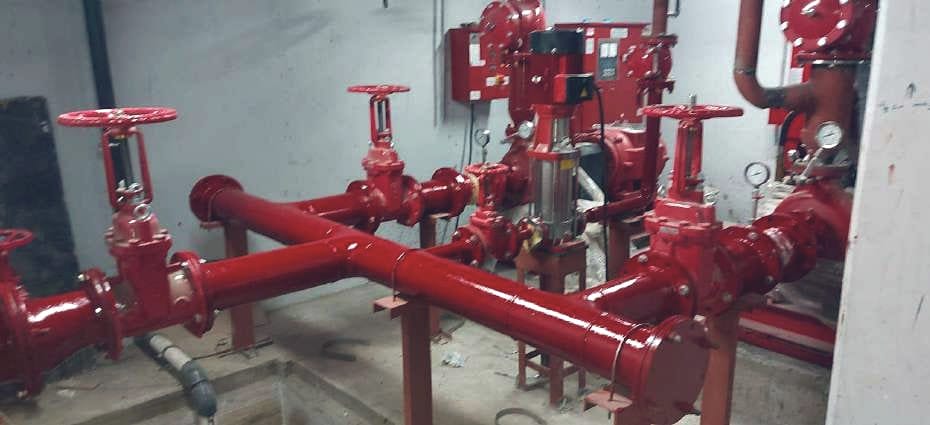
- Fire pump rooms
- Control valves and flow switches
- Hydrostatic pressure testing
- Handover documents
Wet‑pipe sprinkler riser Illustration, not to scale · Dashed line below the floor: supply from the water source
Drawing key
- 1 Riser, from the water supply
- 2 Control valve, OS&Y, locked open with a chain and padlock (or a tamper switch where required)
- 3 Main drain valve, to drain
- 4 Pressure gauge
- 5 Waterflow alarm switch, vane type
- 6 Cross main
- 7 Branch lines
- 8 Pendent sprinklers below the ceiling
- 9 Inspector's test connection: valve, sight glass and orifice equal to the smallest sprinkler, to drain
Built first, promised second
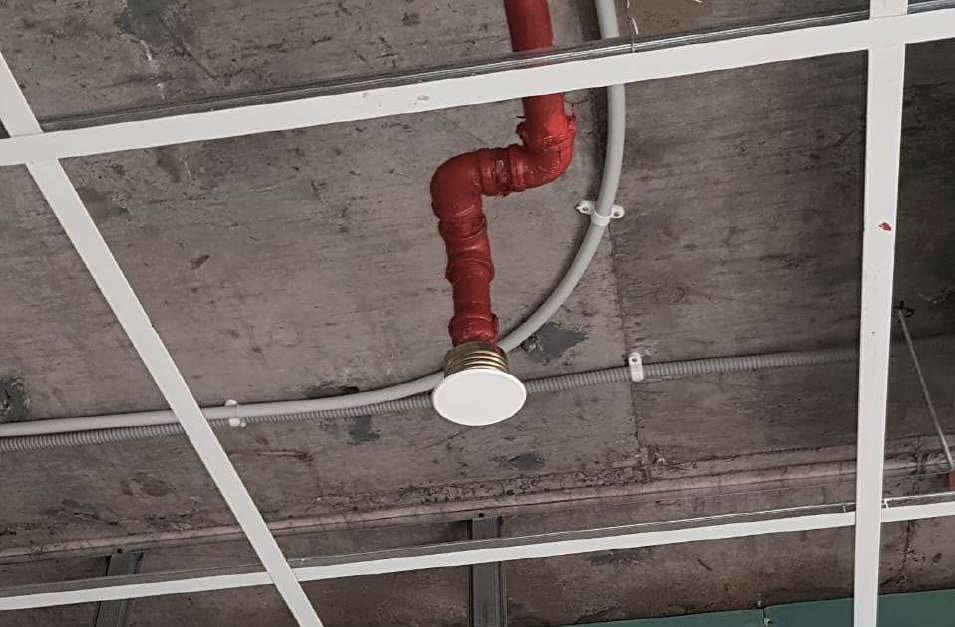
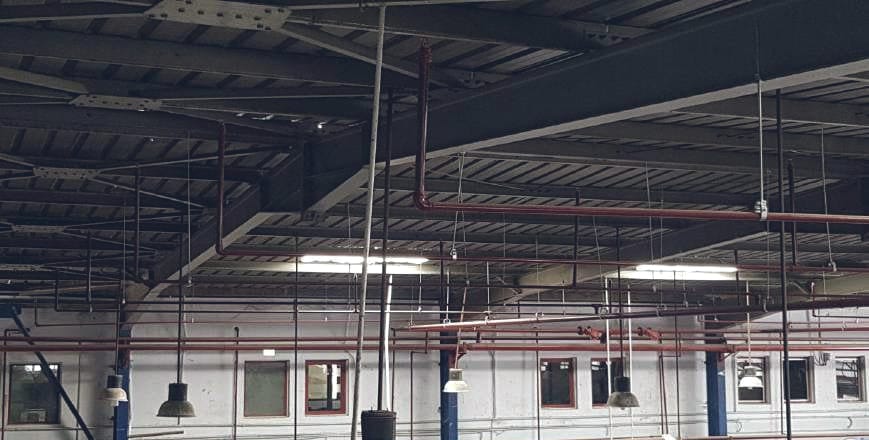
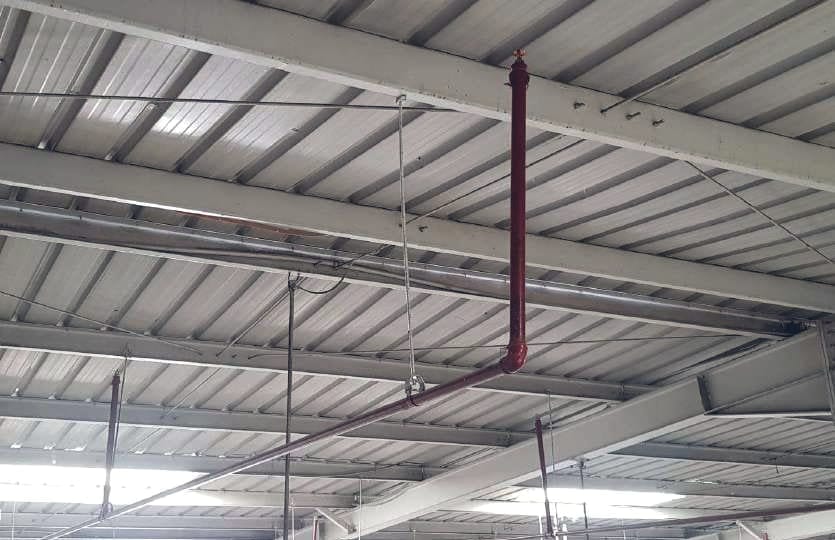
Work completed by HTC Fire Protection
Documented projects
From HTC's project register: 137 documented projects since 2010
- Egyptian General Company for Tourism and Hotels (EGOTH), Abu Simbel
- Idra power station, Ain Sokhna
- Titan head office, Mivida
- Cairo Airport Company for Passenger Services, maintenance centre
More documented projects (2) (4)
- Titan head office, Mivida
- Cairo Airport Company for Passenger Services, maintenance centre
- Al Kheir Wal Baraka Specialised Hospital
- Lectro factory, Borg El Arab
We work in every governorate of Egypt
Shaded governorates are where we have documented projects
| Governorate | Projects |
|---|---|
| Cairo | 42 |
| Alexandria | 10 |
| Giza | 7 |
| Qalyubia | 5 |
| Sharqia | 5 |
| Ismailia | 4 |
| Suez | 3 |
| Red Sea | 2 |
| Beheira | 2 |
| Dakahlia | 2 |
| South Sinai | 2 |
| Matrouh | 2 |
| Port Said | 2 |
| Aswan | 1 |
| Gharbia | 1 |
| Minya | 1 |
| Monufia | 1 |
Clients include
- EGOTH
- Cairo Airport Passenger Services
- Hilton Taba
- Knauf
- Danone
- Pharma Swede
- UTOPIA PHARMA
- Zahran
- Idra Power
- Titan
- Heart Academy Hospital
- Sea Grain
Hydrostatic testing, commissioning and handover
- Site survey
- Design and calculation
- Supply
- Installation
- Testing, commissioning and handover
- Periodic maintenance
Value engineering: the same protection, for less where the code allows
We size the sprinkler and standpipe demand to what the Egyptian Code for Fire Protection of Buildings (305) requires for the actual hazard, take the stricter of it and NFPA item by item, then select the pumps and pipes for that demand.
4 standpipes
The usual solution
4,750 L/min for the standpipes under clause 2‑6‑8‑1.
Ours, by the code
In a building sprinklered throughout with a combined system, the standpipe demand need not exceed 3,800 L/min unless the authority requires more, and it serves the sprinklers without a separate estimate unless their own demand with hoses is larger.
Basis Clauses 2‑6‑8‑1 and 2‑6‑8‑3 (a) of part 4 of the Egyptian code
To be checked against the code in force and approved by a qualified engineer.
For contractors: your fire protection subcontractor
Supply, installation and testing at contractor pricing, with the handover documents and the tests required for acceptance.
48 working hours Free review of a BOQ or a quotation you received — technical notes and saving opportunities, no obligation.
What you get back from the review:
- What complies Items that meet the project and the code, left as they are.
- What exceeds the requirement What can be removed or downsized without a breach: the saving.
- What is missing What could fail the inspection if it stays missing.
- Which quantities need checking Quantities we ask you to check against the drawings.
Questions for a fire fighting company in Egypt
How much does a fire fighting system cost in Egypt?
The hazard, area, height, number of outlets, the pump and the tank set it, against the same BOQ items; contractors get contractor rates.
Send a BOQ or drawings for a written quotation, or for free notes and savings within 48 working hours.
Upload a BOQ file (opens WhatsApp in a new tab) What should I compare when choosing a fire fighting company in Egypt?
Compare items, not totals: what the price includes and excludes, the listing of the pump, and the tests. A system below the code may be rejected and you pay twice.
We use lower‑cost alternatives the code accepts: NFPA 14 accepts locking supply valves open as supervision.
- NFPA 14 §6.3.7.1
Which code applies, and will the system pass the inspection?
The decision belongs to the Civil Protection authority, not to us or any contractor, so we do not promise it.
What we commit to: a design to the Egyptian Fire Code (305) — the binding code in Egypt — with NFPA 13 and 14, the hydrostatic test, and the handover documents.
Do you supply and install, or install only?
Both. We supply and install as a turnkey contractor for owners, or install and test as a subcontractor against the main contractor’s BOQ, with the equipment the project specifies.
The quotation states which items we supply and which are by others, so nothing is added after signing.
Request a quote on WhatsApp (opens WhatsApp in a new tab) Extra items after signing, delays or a failed test: what then?
The quotation lists what is included and excluded, the time and the stages; we run and record the hydrostatic test before ceilings close.
You receive the handover documents and the tests required for acceptance.
How long does installation take?
It depends on the area, floors, outlets, equipment and site readiness, so we do not quote a general figure.
We state the time and stages in writing in the quotation after the site visit, and agree any shutdown with you first.
Who looks after the system after handover?
We offer maintenance contracts to NFPA 25: valves, flow switches, sprinklers, hose cabinets, hydrants and pump runs.
Every visit ends with a technical report listing only what needs fixing, and we prepare the facility for the Civil Protection inspection.
Request a fire fighting quote
A ready WhatsApp message, or a three‑step form.
On WhatsApp
0104 454 5111 (opens WhatsApp in a new tab) Request a quote on WhatsApp (opens WhatsApp in a new tab)- Call
- 0128 820 0050
- Coverage
- all governorates of Egypt
What happens next
- The chat opens with a ready message; fill in the blanks and send.
- We reply during working hours and ask for what pricing needs: drawings, a BOQ or site photos.
- A site visit, then a written quotation with items and time.